Smart freight & city planning: how UT’s Center for Transportation Research is tackling urban traffic and shipping costs
Ever wonder why shipping costs keep rising while downtown traffic gets progressively worse? The answer often lies in a hidden urban challenge: disorganized freight systems and land-use sprawl. When warehouses, fulfillment hubs, and retail destinations are spread out without clear spatial coordination, delivery vehicles spend more time idling in traffic, burning fuel, and traveling longer distances. That friction leads to higher shipping rates for consumers, increased carbon emissions, and worsening road congestion for local commuters. To address this challenge, researchers at the Center for Transportation Research (CTR) at the University of Tennessee are developing data-driven solutions to optimize freight movement across the state.
Mapping Freight and Land-Use Dynamics Across Tennessee
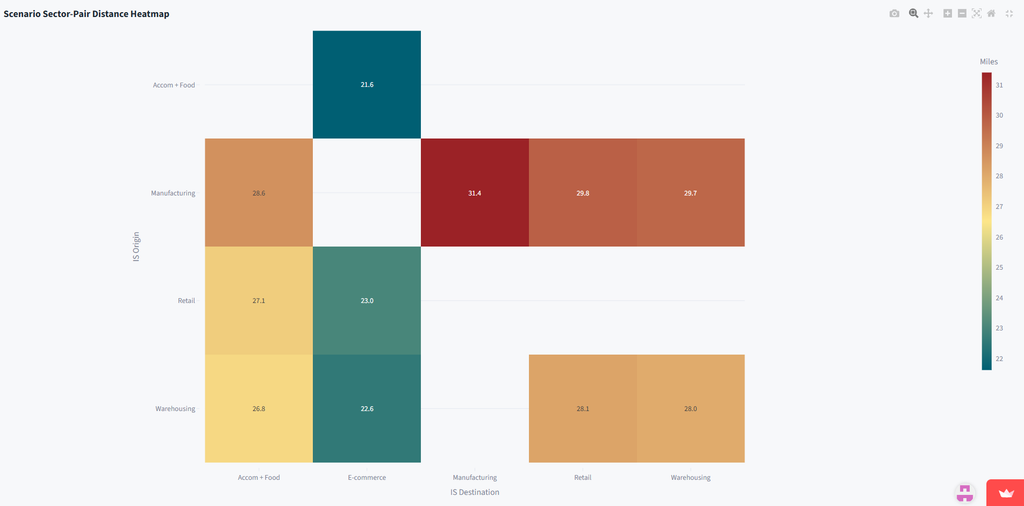
Led by Oriana Calderón, alongside Usman Ahmed, Katherine Asmussen, and Graduate Research Assistant Manuela Córdoba-Misas, a new CTR research project evaluates the direct relationship between freight activity and land-use patterns across Tennessee’s five major metropolitan areas. By synthesizing multi-source data including employment metrics, population density, and trip distance logistics, the research team developed an interactive planning framework. This tool gives urban planners a clear visual assessment of where warehouse footprints and retail hubs are too dispersed, where freight hubs are optimally positioned, and how land-use decisions directly impact daily traffic flow and logistics costs.
Case Study: Optimizing Knoxville’s Urban Supply Chain
When applied locally in Knoxville, Tennessee, the framework revealed a high-impact finding. Shifting even a modest share of warehouse and logistics activity closer to the city core significantly reduces vehicle miles traveled for last-mile deliveries. By strategically repositioning logistics nodes closer to consumer demand, the model demonstrated immediate benefits, including reduced downtown congestion, faster last-mile delivery transit times, and lower operational costs and carbon emissions.
Evidence-Based Tools for Future Infrastructure Decisions
Funded by a grant from the Center for Freight Transportation for Efficient & Resilient Supply Chain (CR2C2)—a U.S. Department of Transportation University Transportation Center—this initiative equips regional leaders with actionable insights. Instead of relying on historical trends or reactive zoning, city officials and metropolitan planning organizations across Tennessee can utilize this interactive model to make informed, evidence-based decisions regarding land use, industrial zoning, and freight infrastructure investments.
Looking Ahead: TRB 2027
As urban populations expand and e-commerce demands rise, optimizing last-mile logistics is critical to building resilient, efficient supply chains. This research project is preparing for a national showcase at the Transportation Research Board (TRB) Annual Meeting in Washington, D.C.